
“Tell me about yourself” might be the most common question you’ll face in a job search — and the most misunderstood. Most people prepare one answer and reuse it everywhere: in interviews, at networking events, in promotion conversations. But a single answer can’t do all of that work.
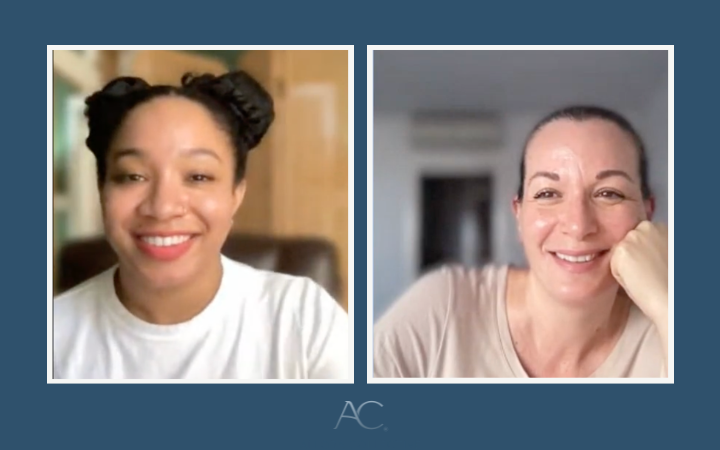
In our latest video, Allora Collective founder Kelly Kugler and US tech careers coach Chez Jennings turned the camera on themselves. Instead of talking about how to answer this question in the abstract, they each gave real versions of their own stories — a career coach and a recruiter doing the exact thing they ask clients to do.
This post breaks down what came out of that conversation: the framework Kelly teaches for thinking about your story, real examples from two different career paths, and the practical advice that actually helps people adapt their answer without losing what makes it theirs. It continues our ongoing series on how job seekers move through today’s hiring process — the throughline across all of it is that your story is the foundation everything else in a job search builds on.
Why “Tell Me About Yourself” Trips People Up
Kelly calls it her favorite interview question — and one of the most underestimated. Most candidates are intimidated by it because it feels open-ended, but that openness is exactly what makes it valuable: it gives you more control over the narrative than almost any other question you’ll be asked.
The upside of preparing it well goes beyond a single interview. The same narratives you build can carry across job searches, networking conversations, interviews, and career pivots — you’re not writing one answer, you’re building reusable material. (0:00–2:01)
You Don’t Have One Story — You Have Three
The core framework Kelly teaches breaks “tell me about yourself” into three distinct versions, each suited to a different context. Trying to use one for every situation is the most common mistake she sees. (7:01–11:01)
- How you got here — your origin story. Your overall career path and the throughline connecting you to where you are now. Best for a new connection, a mentor conversation, or a casual networking intro.
- Why you’re here — your job search pitch. A targeted, forward-facing version that connects your background directly to a specific role. Best for a recruiter screen or hiring manager intro.
- Where you belong — your career growth pitch. A vision-forward version for internal conversations, promotion discussions, and stretch opportunities.
One version isn’t more correct than the others — they’re built from the same material, just shaped for a different audience and purpose.
The Origin Story: How You Got Here
Chez’s path
Chez’s origin story starts further back than most people would expect: her first role in the industry was as a receptionist at a staffing agency, which turned into a light-industrial staffing role. From there she moved into creative-services staffing, where she began placing candidates at tech companies — and started noticing that the tech world was where she wanted to be.
She worked through a series of early-stage startups before landing at Lever, the HR-tech company, which she credits with shaping many of her best practices. From there she moved to Reddit, where she worked two separate stints spanning both the pre- and post-IPO periods. It was during a COVID-era webinar series — where she and Kelly first met — that the idea of coaching started to take hold alongside her recruiting work. Coaching has since become her throughline, layered on top of a 13-year recruiting career. (11:13–15:50)
Kelly’s path
Kelly’s story starts in a different field entirely: she studied to become a teacher and taught students of every age before deciding she didn’t want a career in public education. She took a chance on a four-person creative-services startup instead, spending just over ten years in production and sales for clients that included record labels and beauty brands.
She moved into recruiting in November 2008, in the middle of the financial crisis. From a series of New York agencies, she built the jobs program at General Assembly, then built the tech recruiting function for the National Football League (NFL). A move to Seattle for Booking.com turned into a relocation to Amsterdam within the year. She eventually left the Netherlands, returned to Los Angeles, and founded Allora Collective in 2020 to do the work on her own terms. She has lived in a few countries since and is now enjoying Spain (17:19–25:23)
Both stories model the same lesson: an origin story isn’t a resume readout. It’s the specific decision points and the throughline connecting them — in Chez’s case, a consistent pull toward the people side of every role; in Kelly’s, a throughline of communication and education that shows up in teaching, production, recruiting, and now coaching.
The Job Search Pitch: Why You’re Here
Chez modeled this version live, as if she were interviewing for a talent-partner role: a PHR-certified talent partner with 13+ years scaling technical and go-to-market teams at high-growth companies, from seed stage through public. Her pitch is built entirely from outcomes, not job titles — building a recruiting function from scratch as a sole in-house recruiter, redesigning an R&D hiring process while raising offer acceptance, and helping scale an engineering org by 438%, from 65 to over 350 people, while partnering with VPs on org design and workforce planning. Her experience spans companies including Reddit, Coinbase, and BetterUp. (31:11–32:55)
Kelly didn’t deliver a separate job search pitch on camera — she noted in the moment that she’d folded it into her origin story instead. That’s a useful teaching point in its own right: the three versions aren’t rigid boxes. Sometimes your origin story already carries the “why you’re here” case, especially when your path has a clear, consistent throughline.
Where You Belong: The Career Growth Pitch
Kelly’s answer focused on the kind of environment she does her best work in: a small founding team, in a staff- or principal-level individual contributor role where her impact comes from influence rather than managing people and running performance reviews. She described wanting to work with people who don’t need to be the one who knows everything — favoring “culture add” over “culture fit,” and a team that’s open enough to learn from the people it works with, including clients. (33:41–35:40)
Chez’s answer centered on a consistent people-focused throughline even as her specific role evolves — from connector, to coach, to what she described as more of a facilitator going forward. She tied that to a broader interest in continuous learning, both for herself and for the people she works with, and how that connects to wellbeing more generally. (35:52–37:32)
What Actually Makes an Answer Work
Closing out the conversation, Kelly and Chez moved from the three-version framework into more practical advice about delivery:
- Assume they’ve read your resume. Don’t repeat your work history — use your answer to give them a reason and a clear example connecting you to the conversation you’re in that day. (42:46)
- Read the room. A recruiter running through a checklist, a warm referral to a senior leader, and a casual social introduction all call for a different version of the same answer. (43:04–43:12)
- Study yourself, not just the company. Kelly’s advice: people spend hours researching the company and the job, and forget to spend any time understanding their own story. (43:39–43:50)
- Invite the other person in. Ending your answer with a question back to the interviewer — rather than treating it as pure Q&A — turns a one-way answer into a conversation. (6:28–7:01)
Kelly also shared a small, specific example of how detail can work in your favor. The takeaway is to notice and use genuine points of connection when you find them: a shared school, a mutual connection, a referral. (44:24 onward)
Key Takeaways
- You have three working versions of “tell me about yourself”: an origin story, a job search pitch, and a career growth pitch — not one answer for every situation.
- Match the version to the audience and the moment, not the other way around.
- Assume the other person has already read your resume; use your answer to explain why the conversation matters right now.
- A specific, human detail makes your story memorable — don’t default to the chronological résumé readout.
- Ending your answer with a question invites the other person into a conversation instead of an interrogation.
Quick Answers
Do I need a different “tell me about yourself” for every situation?
Yes. Kelly and Chez work from three versions: an origin story for networking and new connections, a job search pitch for recruiter and hiring manager conversations, and a career growth pitch for internal, promotion, or vision-setting conversations. Using the wrong one for the context is the most common mistake.
Yes. Kelly and Chez work from three versions: an origin story for networking and new connections, a job search pitch for recruiter and hiring manager conversations, and a career growth pitch for internal, promotion, or vision-setting conversations. Using the wrong one for the context is the most common mistake.
What’s the biggest mistake people make with this question?
Repeating their resume in chronological order, or going so high-level that there’s no real context. Kelly’s advice: assume the interviewer has already read your resume, and use your answer to explain why the conversation matters right now.
Repeating their resume in chronological order, or going so high-level that there’s no real context. Kelly’s advice: assume the interviewer has already read your resume, and use your answer to explain why the conversation matters right now.
Plain definitions
- Origin story: your career narrative and throughline — best suited to networking, new connections, and casual introductions.
- Job search pitch: a targeted version built around outcomes rather than job titles, aimed at a specific role — used in recruiter screens and hiring manager conversations.
- Career growth pitch: a forward-looking version focused on where you’re headed — used for internal promotion, sponsorship, or leadership conversations.
Watch the Full Conversation
Video Timestamps
- 0:00 – Welcome, and why we’re turning the camera on ourselves
- 2:01 – Why “tell me about yourself” trips people up
- 7:01 – The three versions of your story
- 11:13 – Chez’s origin story
- 17:19 – Kelly’s origin story
- 31:11 – Chez’s job search pitch, modeled live
- 33:41 – Kelly on where she belongs
- 35:52 – Chez on where she belongs
- 41:13 – The most common mistakes — and how to fix them
- 44:24 – A small detail that changed the outcome of an interview
Ready to Build Your Own Version?
Your story is the foundation everything else in a job search builds on — the resume, the networking outreach, the interview prep all build on top of it. If you’re not sure which version of your story to tell, or you’ve been using the same one everywhere, that’s exactly what we work through with clients.
Watch the full series on our YouTube channel: @alloracollective.


